Storm Damage to Overhead Lines: ComEd vs. Electrician
Storm pulled your overhead power line loose? Learn what ComEd fixes, what falls on your electrician, and how storm-damage repairs usually go at your home.
When a Storm Takes Down Your Overhead Power Line
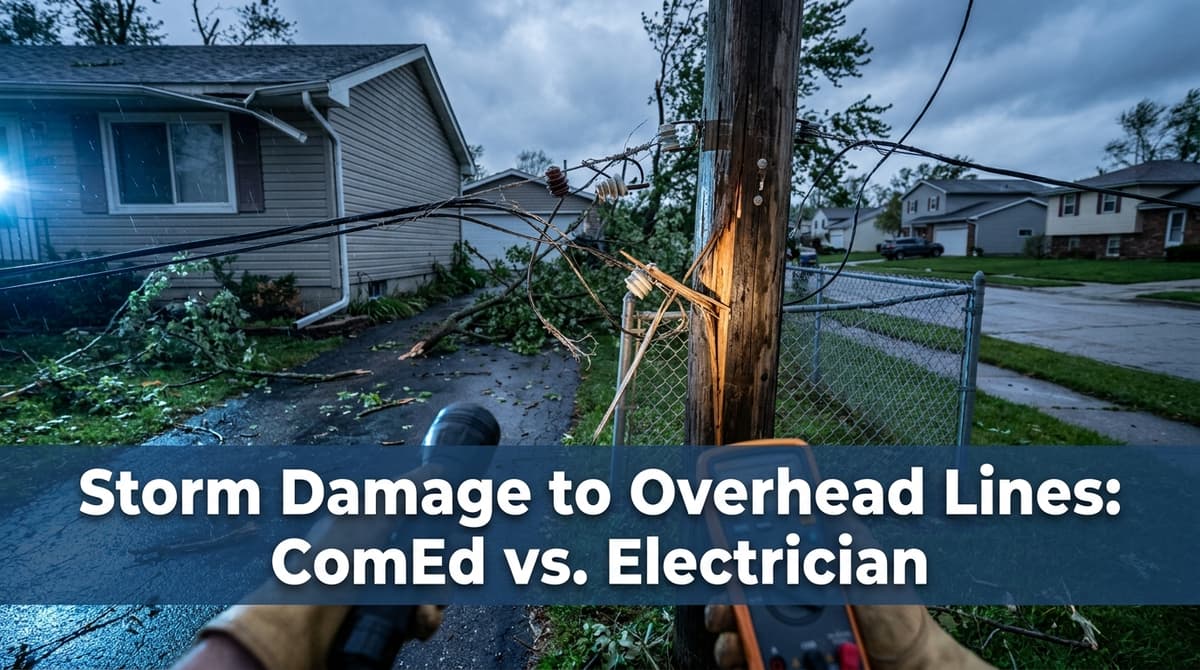
We recently got a call from a homeowner — let’s call her Kay — right after a big Midwest storm rolled through. A tree had come down in her yard and pulled the overhead line from the pole. The wire was twisted in the tree, still connected to the house, and her power was somehow still on.
Kay told us, “Somebody said once ComEd comes out, I’ll have to call an electrician to reconnect it. Is that true? Doesn’t ComEd do all of that?”
As licensed electricians, we get this question all the time after storms. The line between what ComEd (the utility) is responsible for and what we as electricians handle can be confusing — especially when there’s a tree hanging on your wires and you’re just trying to keep the lights on.
Kay’s Situation: Tree, Line, and a Lot of Uncertainty
In Kay’s case, the overhead service line from the pole was pulled into the tree but hadn’t completely detached from the house. The meter, service mast, and connection point at the house were all still physically there, and the power was still working. She was waiting on ComEd but couldn’t get clear answers on what would happen next.
On the phone, we walked her through the basics and asked her to send photos: a step-back picture of the whole setup, close-ups of where the line connects to the house, and the area around the meter. The more angles we can see, the better we can advise someone before a technician ever steps on site.
From that conversation, we realized this would be a helpful topic to break down for other homeowners dealing with storm damage to overhead lines.
What ComEd Typically Handles After Storm Damage
The first piece of good news: you’re not on your own for everything. ComEd is generally responsible for the utility-owned equipment up to a certain point. While exact policies can vary and you should always confirm with ComEd directly, here’s the typical breakdown we see in our area:
- Lines from the pole to your house: The overhead service drop (the wires from the utility pole to your home) is usually ComEd’s responsibility.
- Repairs at the pole: Anything on the pole itself, including transformers and high-voltage lines, is strictly the utility’s job.
- Disconnecting dangerous lines: If a tree pulls the line down and it’s sparking, low-hanging, or lying on the ground, ComEd will typically come out to make it safe and restore service to the neighborhood.
As we explained to Kay, ComEd may reconnect to your home’s service point if everything on the house side is still intact and up to code. But that “if” is where electricians like us come in.
What Falls on the Homeowner and the Electrician
On almost every storm-damage call, we end up clarifying this key line: ComEd handles their equipment; you’re responsible for the electrical equipment that’s part of your home.
In practical terms, that usually means the homeowner (through a licensed electrician) is responsible for:
- Service mast and weatherhead: The metal pipe and cap where the wires attach at your roof or wall.
- Service entrance conductors on the house: The wires running down from the weatherhead into your meter and panel.
- Meter socket and mounting: The box that holds the meter and how it’s secured to the house.
- Main electrical panel and grounding system: Everything from the meter into the heart of your home’s electrical system.
When any of those components are bent, pulled loose, cracked, or no longer mounted securely, ComEd will usually refuse to reconnect until a licensed electrician repairs or replaces them. That’s exactly what we told Kay: if her equipment on the house was damaged or not “up and proper,” ComEd would require it to be fixed before they hook the service back up.
Typical Scope of a Storm-Related Service Mast Repair
Homeowners often ask us, “What does that repair actually involve?” so they can prepare. While every home is different, a typical storm-damage service repair might include:
- Removing any loose or unsafe service mast, meter socket, or conduit
- Installing a new service mast and weatherhead sized correctly for your home’s service
- Re-securing the mast properly to the structure (often with new brackets or supports)
- Replacing the meter socket if it’s cracked, pulled away, or outdated
- Checking and updating grounding and bonding connections
- Verifying the main panel connections are safe and code-compliant
As licensed electricians, we also coordinate with ComEd when needed — for example, arranging a temporary disconnect so we can work safely, then scheduling a reconnect once the repair passes inspection (if your local jurisdiction requires one).
How Long Do These Repairs Usually Take?
During a big storm event, timelines can stretch out, but under normal conditions, here’s what we typically see:
- Initial assessment: With clear photos like we asked Kay to send, we can often give you a preliminary plan the same day. If we need an on-site visit, that’s usually scheduled within 24–48 hours, depending on storm demand.
- Actual repair work: Most standard service mast and meter repairs take between 4–8 hours of on-site work.
- Inspection and reconnect: If the city or county requires an inspection, that can add anywhere from a few hours to a couple of days, depending on how backed up they are and how busy ComEd is during the storm aftermath.
Our goal is always to get your home safe and ready for utility reconnection as quickly as possible, while staying fully compliant with code and utility requirements.
Common Code Issues We Find After Storms
Storms don’t just break things — they also expose older issues that were already there. When we’re called out after a tree or wind event, we often discover:
- Undersized or outdated service equipment: Old meter sockets or panels that no longer meet current code or load demands.
- Improperly secured masts: Loose brackets or rusted hardware that made it easier for the mast to pull away when the line was stressed.
- Missing or inadequate grounding: Ground rods not connected properly, corroded clamps, or bonding that doesn’t meet modern standards.
- Water intrusion issues: Damaged weatherheads or cracked conduit that allow water into the system, which storms make painfully obvious.
When we’re already on-site for a storm repair, we’ll point these things out and give you options. Sometimes it’s as simple as tightening and cleaning connections; other times it’s a good opportunity to bring your whole service up to current safety standards.
What You Should Do Right After Storm Damage
If you ever find yourself in a situation like Kay’s, here’s the basic game plan we recommend:
- Stay away from any downed or low-hanging wires. Assume every wire is live until the utility confirms otherwise.
- Call ComEd to report the outage or damage. They need to know there’s an issue on their system.
- Take clear, safe photos from a distance. Step back and capture the entire service from the pole side to the house, plus close-ups of the meter and mast if safe.
- Contact a licensed electrician. Send those photos so we can tell you whether your home’s equipment likely needs repair before ComEd will reconnect.
- Be prepared for coordination. In many cases, there’s a back-and-forth between you, your electrician, ComEd, and sometimes your city’s inspection department.
That’s exactly what we started with for Kay: gather information, review photos, and be ready to step in as soon as ComEd made their part safe.
We’re Here to Help You Navigate the Utility Line
Storm damage is stressful enough without having to guess who’s responsible for what. Our job is to handle everything on the house side of the line — safely, up to code, and in sync with ComEd’s requirements — so when the utility is ready, your home is too.
If a recent storm has left your overhead power lines sagging, tangled in a tree, or pulled away from your house, we’re happy to look at photos, explain your options, and help you plan the next steps. As licensed electricians, we deal with this kind of situation all the time, and we’ll walk you through it just like we did with Kay.
You don’t have to figure out ComEd versus electrician responsibilities alone — that’s exactly what we’re here for.